
Park in any retail car park after a downpour. What do you see? Large pools cover most of the parking area. Staff wading through puddles to get to their cars. Customers attempting three-point turns to escape the flooded car park. The South West receives significantly higher rainfall than anywhere else in the country, and our soil – predominantly clay – does not readily absorb water. Here’s why commercial drainage keeps failing on your site in South West and what actually works.
Key Takeaways:
- Soakaways don’t work on clay – the water just sits there. Always has, always will.
- SuDS (Sustainable Drainage Systems) are now mandatory – new national standards were established in June 2025. If you ignore them, your planning application will be rejected.
- Attenuation tanks store water – they hold excess water during rainfall and then slowly release it. This eliminates the need for infiltration.
- Surface water and foul water are different – mixing them up causes bigger problems.
- Design early, not as an afterthought – drainage has to be in the initial plans now.
Why Does Water Pool on South West Commercial Sites? The Clay Problem
You have a commercial site. Could be anything: car park, warehouse, retail unit, office, light industrial. What it probably does have in common is puddles every time it rains and the water sits there on the surface for many hours or even days.
The thing is, the cause of that problem is right under your feet. Most soils in the South West are a type of clay. The particles of our clay soil are so small they pack incredibly tightly together and don’t let water penetrate through them or let it through very slowly.
We’ve done soakaway tests where after 3 hours, the water level hadn’t dropped an inch. This just proves that the idea of a soakaway simply is not feasible in the South West UK. The classic DIY approach of digging a hole and filling it with stones and calling it a soakaway will not and never has worked in these conditions.
Unfortunately for you, when the car park floods again for the third time this winter, you are going to be on the phone with your contractor, “our car park’s flooded again. Can you sort it?”
What Are the New SuDS Regulations and How Do They Affect You?
Here’s the thing. Even if you wanted to build a DIY soakaway, that option does not exist anymore.
Defra published new National Standards for Sustainable Drainage Systems in June 2025. They replace the standards of 2015 and demand much more emphasis be placed on surface water management. A surface water solution has to be designed now from the start of a site development rather than adding it on at the end.
For applications submitted after 1st January 2026, if your drainage doesn’t meet the new standards, it will be rejected. Full stop.
Cornwall Council – and every other Lead Local Flood Authority – is enforcing this. You need a proper surface water drainage strategy with your planning application. Soakaway testing results. Attenuation calculations. Maintenance plans.
It’s not optional anymore.
What Drainage Solutions Actually Work on South West Clay?
So if soakaways are out, what’s in?
| Solution | How It Works | Best For |
| Attenuation Tanks | Underground storage that holds stormwater and releases it slowly. No infiltration needed. | Large sites, car parks, retail parks |
| Oversized Pipe Systems | Bigger pipes act as temporary storage during storms, then release slowly. | Smaller sites, straightforward layouts |
| Permeable Paving | Water goes through the surface into a stone storage layer underneath. | Car parks, driveways, pedestrian areas |
How Do Attenuation Tanks Prevent Flooding on Commercial Sites?
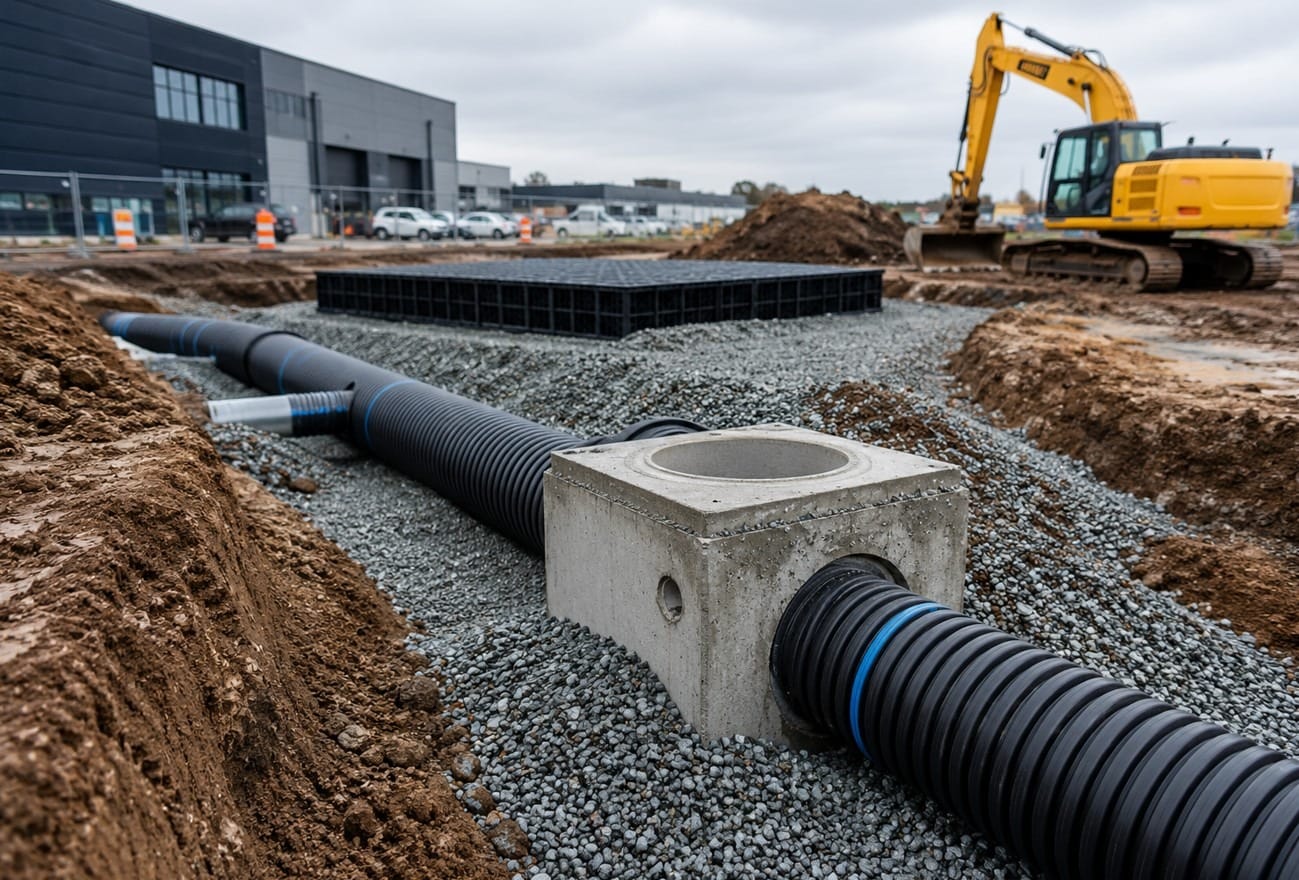
Attenuation tanks are our go-to solution for most commercial sites. Modern ones are modular plastic crates that lock together. Strong enough to take vehicle loads. Last for decades.
Water runs into the tank during storms, fills it up, then releases slowly through a flow control chamber. It’s simple, reliable and doesn’t rely on the ground soaking anything up.
Can Oversized Pipe Systems Work for Commercial Drainage?
Oversized pipe systems work well on smaller sites. Simple, cost-effective & no moving parts. The pipes act as temporary storage – they fill during storms and then empty slowly.
They’re not suitable for every site but when they work they’re a neat solution.
Why Can’t You Mix Surface Water and Foul Water Drainage?
Surface water from rain from roofs and car parks is different from foul water that comes from toilets, sinks or industrial waste.
Mix them up and you’re asking for trouble. Foul water needs treatment. Surface water just needs managing.
The new SuDS standards only apply to surface water. But if you’re connecting to public sewers, you still need to check capacity with the local sewerage undertaker. Some networks are already overloaded.
How Does Canno Fix Commercial Drainage Problems? Our Step-by-Step Process
Here’s how we fix commercial drainage properly:
| Step | What We Do |
| 1. Site Survey | We assess your site, ground conditions, and existing drainage |
| 2. Soakaway Testing | To confirm whether infiltration’s possible (it usually isn’t on clay) |
| 3. Design | We calculate storage volumes, pipe sizes, and flow rates |
| 4. Planning | We prepare the drainage strategy for your planning application |
| 5. Installation | We dig, lay, and connect everything properly |
| 6. Sign-Off | We provide certification and maintenance plans |
Frequently Asked Questions
Why do soakaways fail on South West sites?
The main reason is the clay soil. It doesn’t allow water to pass through. That’s it.
What are the new SuDS rules?
The new sustainable drainage system (SuDS) rules published June 2025 state that water quality, amenity and biodiversity must be explicitly addressed right from the beginning of a construction project.
Do I need planning permission for commercial drainage?
Definitely. You have to submit a surface water drainage strategy with your application.
What’s an attenuation tank?
It is a type of underground storage which stores rainwater and releases it gradually. Since it doesn’t rely on infiltration, it is possible to use it even on clay soil.
How much does commercial drainage cost?
It really depends on things like how large the site is, ground conditions, and system design. We try to give a quote to each project based on its specifics.
Can you fix existing drainage that keeps flooding?
Usually yes. We use a CCTV survey to identify the issue and then we develop the appropriate resolution.
Conclusion
We get it, drainage isn’t an interesting topic. But if you’re facing problems, one downpour could cost you thousands. The legislation has changed, the climate is evolving, and clay soil remains stubbornly… well, clayey.
We design drainage systems that actually deliver. Attenuation tanks, oversized pipes, permeable paving… whatever the site demands, it’ll be calculated precisely, installed properly and signed off accordingly.
If flooding is costing you money on your new site, get in touch with Canno Construction. We’ll survey your site, design the right system and stop the water where it belongs – away from your business.