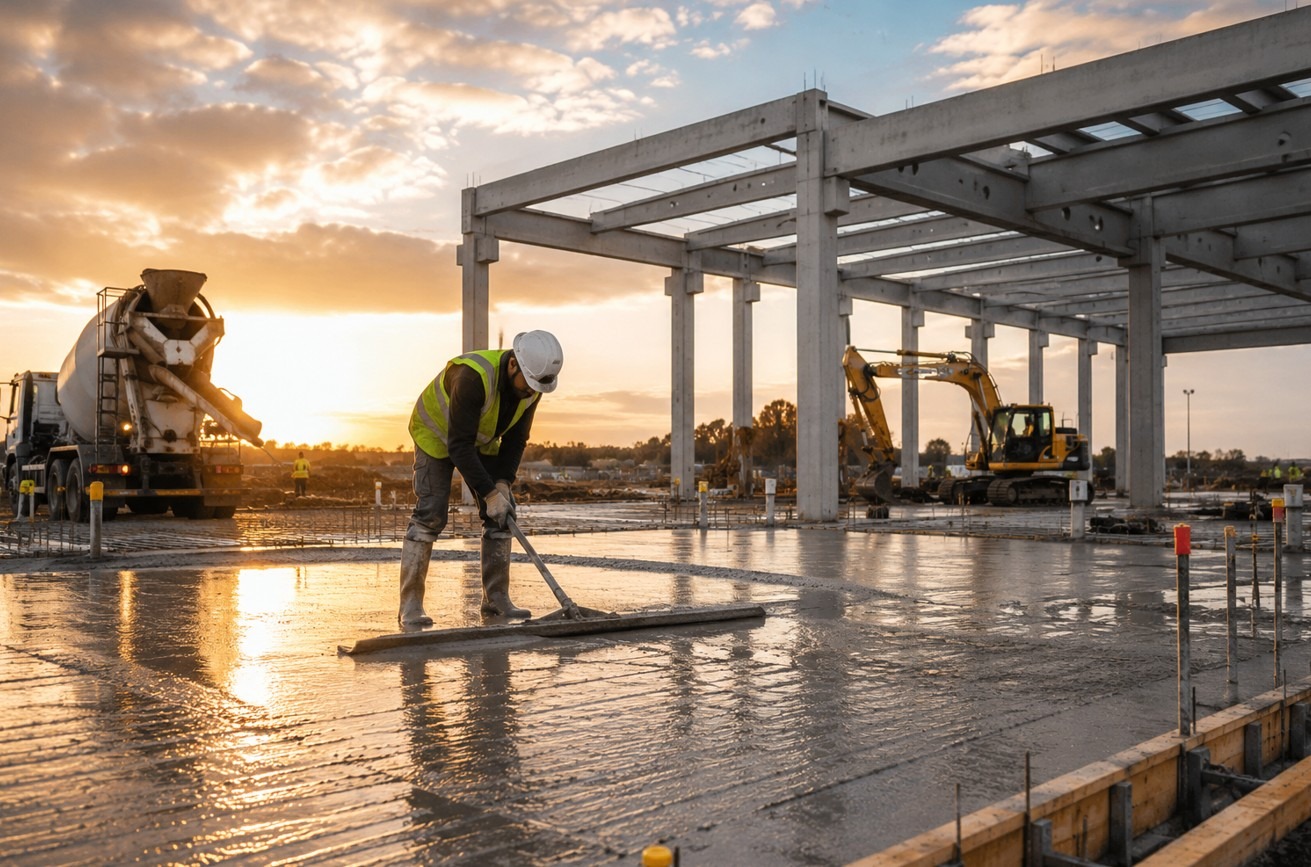
You have just bought a new commercial unit. All your storage equipment is ordered. The forklift truck is ready to go. Your staff have just moved in. That’s brilliant. But just 6 months into operations the floor is dusty. After 18 months, your epoxy floor is peeling off. This is not simply a floor; it’s a big risk. This is something we come across every week here in Devon and Cornwall. Here are 5 mistakes why your commercial concreting South West is likely to fail and why it will cost you and and how we make sure it never happens.
Key Takeaways:
- Moisture ruins everything – If the vapour barrier is skipped or installed incorrectly the covering system will ultimately fail.
- Sub base is non-negotiable – Insufficient sub base material will ensure the movement of the underlying soil resulting in cracks.
- Water weakens concrete – It’s easier to lay the concrete with too much water but the floor becomes weaker.
- Curing time is non-negotiable – Rushed concrete is weak concrete. Seven days is our minimum recommendation.
- Joints control cracking – Wrong placement means cracks where you don’t want them.
When Moisture Damages The Flooring
This is the most expensive mistake we fix.
Commercial floors need a damp-proof membrane underneath. Without it, ground moisture migrates up through the slab. You won’t see it at first. But when you lay your floor covering – epoxy, vinyl, tiles – that moisture gets trapped and pushes up from below. The covering bubbles and fails.
Job we fixed: New industrial unit near Bodmin. Beautiful epoxy floor. Twelve months later, it looked like a relief map. The client shut down for two weeks while we ground it back and started again.
The cost? Initial saving on the vapour barrier: about £500. Repair bill: £18,000. Plus lost business.
What we do: 1200-gauge polythene sheet under every slab. Lapped, taped, properly installed. We test moisture before any covering goes down. If it’s not dry, we wait.
Ground That Moves Beneath You
The South West is mostly clay. Clay will swell when it is wet and it will shrink when it is dry. This kind of movement will directly affect your slab if you have not done your groundwork properly.
There was a case when a floor’s sub-base was just a bit of hardcore, thrown over mud. Looked fine when it was put down. Then the clay did its thing, the ground shifted, and the slab cracked.
You will only realise when the forklift truck has started bouncing. At that point, the floor has been compromised.
Our sub-base process:
- First, we dig 150mm minimum for commercial floors
- Secondly, lay geotextile membrane to separate stone from clay
- Thirdly, bring in MOT Type 1 limestone, it is sharp and it locks together
- Compact in three layers with a vibrating plate
Do this well and the floor will remain level. Do it badly and you will be looking at a total replacement.
The Concrete Mix That Causes Cracks
Here’s something most people don’t realise. The concrete mix arriving in the truck needs to be right. Too much water makes it easier to lay but weaker. Wrong aggregate size leads to segregation. Too little cement and the surface dusts.
Job we fixed: Exeter site. Client ordered the cheapest readymix they could find. Eighteen months later, the surface was crumbling under pallet truck traffic. Dust was getting everywhere. They closed for a week while we ground it back and applied a hardener.
Our approach: We specify every mix based on end use. Heavy forklifts get a different mix to retail. Cold storage gets something else. We test every pour on site and send samples to the lab. If it’s not right, it doesn’t go down.
The Concrete Cure That Got Rushed
This one’s frustrating because it’s so easy to avoid. Concrete needs time to cure. It needs to stay damp at a stable temperature for at least seven days. If it dries too fast, it shrinks, cracks, and ends up weaker than it should be.
The pressure to finish is always there. Client wants to fit out. Contractor wants to clear the site. Everyone’s in a hurry. But concrete doesn’t care about your schedule.
The result: A floor that’s maybe 60% of designed strength. Cracks within months. Surface wears out years early.
We don’t rush. We use curing compounds, wet hessian, or plastic sheeting to keep moisture in. We protect the floor for the full curing period. Tell clients upfront – the wait’s worth it. A properly cured floor lasts decades. A rushed one might not last the year.
Joints That Fail to Control Cracking
Concrete dries by shrinking. It also expands and contracts as the temperature changes. You need to provide joints in correct locations to decide the cracking areas.
If you space the joints incorrectly, the concrete will crack at the spots it wants to – usually through the high-traffic areas or the ones under racking. The floor edges will be broken up, will create trip hazards, and it will look ugly.
Common mistake: Joints too far apart or not cut early enough.
Our joint design: We plan the location of contraction joints with consideration of the thickness of the slab, reinforcement, and the layout of the building. Normally, joints 4-5 metres apart for industrial slabs. We perform the saw cutting within 24 hours of pouring before the random cracking starts.
Frequently Asked Questions
How much does a commercial concrete floor cost?
£50-£120 per square metre depending on spec, sub-base prep, and finishing.
What causes concrete floors to dust?
Too much water in the mix or poor finishing. Weak surface = dust.
How long before you can drive forklifts on new concrete?
Seven days minimum for light traffic, 28 days for full loads.
Can you fix a dusty concrete floor?
Sometimes with surface hardeners, but prevention’s always cheaper.
What’s the biggest mistake in commercial concreting?
Skipping the vapour barrier. Always.
How long does a commercial concrete floor last?
50 years plus if done right. 5 if done wrong.
Conclusion
Here’s the thing. Construction budgets are tight. Deadlines are tight. It’s tempting to cut costs wherever possible.
But concrete is unforgiving. If you reduce the quality, you will have to pay for it at hand, in repairs, downtime, lost business. A floor being a base of your business, need to be set correctly from the very beginning.
We make floors for the long haul. Foundations that can cope with the Devon clay. Slabs that don’t move under the heaviest loading. Floorings that don’t give up, year after year.
Good flooring should be considered as an investment rather than an expense.
If you are considering a new commercial floor, do not hesitate to contact Canno Construction. We will give a fair quote, build a quality project, and back it up with our guarantee.