
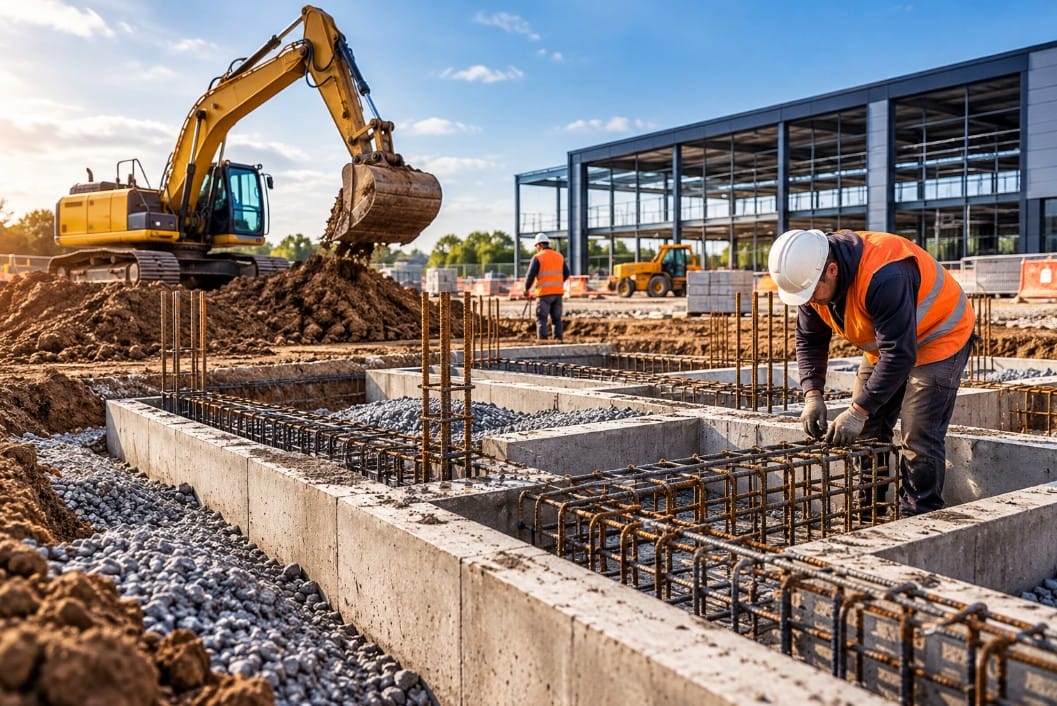
You know that sinking feeling that hits you when you see a crack running up the wall of your new building. It wasn’t there last week and makes question if perhaps you should have paid a bit more attention to what was underneath. Foundation settling is a real phenomenon. Here are 3 commercial foundations South West failures we have fixed. Each one failed for a different reason. Each one cost someone thousands. And each one could’ve been avoided.
Key Takeaways
- Architects plan for ideal ground, reality often turns out very different.
- Clay soil doesn’t just stay still, it actually changes with the weather.
- Trees consume much more water than you imagine, a single thirsty tree can cause serious damage to your foundations.
- Most inexpensive quotes generally leave out important aspects such as ground investigation.
Problem #1: Tree Roots Causing Foundation Movement
Here’s a fact few people understand. The ground you’re standing on isn’t static. It moves. Constantly.
In fact, much of the South West is built on a type of ground referred to by engineers as ‘shrink-swell’ clay. Don’t let the technical name fool you. When clay gets wet, it expands and when it dries out, it shrinks. This expansion and contraction create tiny ‘ripples’ through the soil, which travel up to the structure built above it.
Recently, we carried out work on a warehouse extension near Barnstaple where, despite the client taking every reasonable step, the extension was beginning to show signs of distress just 12 months after it was built. Doors were sticking and one end of the building floor had sunk by a whopping 30mm.
The main issue was that the contractor had fitted the building with conventional strip foundations set into a site, situated at the bottom of a slope, where all water runs.
While 30mm may not sound like a large figure until you’re trying to get a rolling shutter door to seal properly, the consequences were significant.
We once took a project in Plymouth. New office block. Beautiful oak tree, 3 metres from the building. Architect said it’d be fine.
Just one and a half years later, the corner of the building was down 40mm. The tree had extracted all the water from the soil. The strip foundations were not deep enough to remain in stable ground.
What we did: Underpinning with piles going 6 metres down into stable ground. The bill came out to be £45,000.
The lesson: One large oak tree drinks 150 litres of water every summer day. That’s 150 litres of moisture taken out of the soil surrounding your foundations. Trees and foundations do not get along without proper planning.
Problem #2: Incorrect Ground Conditions Assumptions
You can’t really tell what’s beneath the ground just by guessing. It’s impossible.
Some years ago, we were working on a project in Exeter. BGS map was indicating sandstone. We opened a trial pit. To our surprise, 4 metres of soft clay were lying above the sandstone. Ground conditions were totally different.
Normal strip foundations would have been sunk. We came up with piled foundations. Our client spent an additional £7, 000. This is almost nothing compared to the amount that fixing a sinking building would have cost them.
A thorough ground investigation usually amounts to around £2, 000-£3, 000 for a commercial site. That is 1% of the overall project budget. And it will be the best 1% of your money that you’ll ever use.
Problem #3: No Ground Investigation Before Construction
Some time ago, we repaired a site in Cornwall. A Cornish businessman constructed a workshop. He used the cheapest groundwork quote. No ground investigation. No tests. The builder said it’s okay.
Three years later, the floor had settled by 60mm. The walls had fissured. The roof had twisted. The whole thing needed underpinning. Cost £60, 000. The value of the workshop was only £100, 000.
The client asked me why. We answered: “The builder was unaware of what was beneath the ground. He took a risk. Unfortunately, he took a bad risk”.
Frequently Asked Questions
Why do buildings on clay move?
The reason behind the movement is the fact that clay gets wet it expands, and when it dries it shrinks. The building gets affected by the movement of the clay.
How deep do South West foundations need to be?
It totally depends on the ground. It can be 600mm. It can be 4 metres. Do a site investigation first.
Can trees damage foundations?
Indeed. Trees extract water from the soil. This can lead to clay shrinking which then results in the movement of the foundations.
What’s the best foundation for sloping sites?
Stepped foundations. Follow the ground instead of fighting it.
How much does a site investigation cost?
£2,000-£4,000 for most commercial sites.
Conclusion
Building on South West ground isn’t complicated. It just needs respect. The ground moves. The weather changes. Trees drink. Slopes slope. You can’t fight any of it. You just need to work with it.
Every one of those three failures could’ve been avoided. A site investigation. The right foundation design. A contractor who knew what they were doing. We’ve been doing this for 10 years. Building on clay, on slopes, next to trees and in flood plains. Every site’s different. Everyone gets investigated, designed and built properly.
If you also plan to start a project soon, give us a call at Canno Construction. We’ll tell you what’s really under your site – before you build on it.